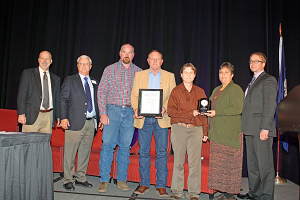
more from the NACD meeting

Monday General Session Recap
The 69th NACD Annual Meeting started off with a great General Session on Monday, February 2. Past NACD President Gene Schmidt presided over the event that included a keynote address by Major General Michael Wehr, Commander for the Mississippi Valley Division of the U.S. Army Corps of Engineers.

The program also included an address by current NACD President Earl Garber, NACD CEO John Larson and a Louisiana welcome address by Lt. Governor of Louisiana Jay Dardenne.

Other highlights of the program were a performance by the Chalmette High School girls choir led by Annelise Cassar, musical director, and the presentation of the colors by the Louisiana National Guard Youth Challenge Program.

Tuesday General Session Livecast
For those of you who were not able to attend this year’s Annual Meeting, you can follow along with us on Tuesday, February 3 when we will live-cast the General Session (9-11:30 AM CT) thanks to the generous services of Brain Allmer of BARN Media. The live webcast can be found on the BARN Media Livestream page or by visiting NACD’s Annual Meeting page.

NACD’s Annual Meeting page also has a link to the full meeting program, a template press release for attendees to use locally, and a link to the daily Annual Meeting coverage page. Don’t forget you can also follow along with us on Facebook (www.facebook.com/conservationdistricts) and Twitter @NACDconserve. Look for the hashtag #NACDAnnualMeeting.

Annual Meeting Leadership Luncheon
Monday’s Leadership Luncheon featured keynote speaker Krysta Harden, Deputy Secretary of Agriculture for the U.S. Department of Agriculture. Harden spoke to a full house of Annual Meeting participants about the importance of not only taking a leadership role, but in being a devoted leader.

Harden pressed the necessity of looking to the past for leadership cues, but not dwelling there at the expense of forward progress. "Look back, but don’t stare," Harden cautioned. "This is about the future," Harden added, "we can do more, we can do better and we can be in front."

Deputy Secretary Harden also spoke about recent Regional Conservation Partnership Program (RCPP) award decisions and the critical role of conservation districts in those accepted proposals. She spoke to the importance of harnessing the tools and relationships conservation districts already have in bringing new people and organizations together for conservation programs like RCPP.

"It’s about digging deeper, being stronger. The future has never been brighter or more hopeful for conservation districts if you remember what leadership is about," Harden said.

2015 Conservation Expo and Share Fair
Two highlights of the NACD Annual Meeting each year are the Conservation Expo and the Share Fair.

The Conservation Expo opened Sunday, February 1, with a record 34 exhibitors. Annual meeting attendees flocked to see exhibits that included representation from conservation-related businesses, nonprofit organizations and government conservation partners.

Soil health was a popular theme at several booths in this the International Year of Soils. Attendees also had a chance for a hands-on experience with the National Resources Conservation Service’s Client Gateway, which is being rolled out in phases across the country. The Expo will be open through Tuesday, February 3.

2015 marks the fourth year for the NACD District Share Fair. This year’s event showcased the accomplishments and programs of ten districts and state associations to more than 400 visitors.

Visit the NACD website to see the variety of projects shared at this year’s event. If you are interested in participating at the 2016 conference in Reno, Nev., applications will be available on the NACD Annual Meeting page next summer.

Posted in Uncategorized | Leave a comment

NACD Annual Meeting

February 1, 2015
NACD Kicks Off Annual Meeting in New Orleans
The National Association of Conservation Districts (NACD) kicked off its Annual Meeting today in New Orleans, Louisiana. The NACD Annual Meeting, February 1-4, brings together conservation leaders from across the nation for educational sessions, workshops and networking. Read the full press release here.

Monday’s keynote speakers will include: USDA Deputy Secretary of Agriculture Krysta Harden; Lt. Governor of Louisiana Jay Dardenne; and Commander for the Mississippi Valley Division of the U.S. Army Corps of Engineers Major General Michael Wehr. Tuesday’s General Session will focus on the past, present and future of conservation with former USDA NRCS Chief Dave White discussing the history of districts and the conservation movement; panelists representing the U.S. Bureau of Land Management, Environmental Protection Agency, Forest Service, Department of Defense, and Fish and Wildlife Service giving an update on current conservation efforts nationwide; and USDA NRCS Chief Jason Weller providing an outlook on the future of conservation in America.

During Tuesday’s Board of Directors meeting, elections will be held for the 2015 NACD Officer team.

This year, NACD in partnership with USDA NRCS will be hosting its first ever student program, bringing in Gulf Coast area college and university students to attend general sessions and a special student career workshop, where they’ll hear firsthand from local conservation districts, national and state partners, and private sector leaders on careers in conservation.

The week ahead: The Conservation Expo Hall opens tomorrow, Monday, February 2. Tomorrow also features the Share Fair and a full day of breakout sessions.

Kick-Off Event at Mardi Gras World
The 2015 NACD Annual meeting was kicked off with close to 200 people visiting Mardi Gras World. Participants were able to view floats lined up for a Mardi Gras parade that will be held soon. A movie highlighted the history of Mardi Gras and the parades.

All enjoyed king cake with a beautiful view of the Mississippi River. The evening ended with costumes and photos next to the beautiful Mardi Gras creations. The NACD Auxiliary hosted the event and money raised go toward the prize for the NACD poster and photo contest.

Posted in Uncategorized | Leave a comment

Cattle to the Rescue

Cattle To The Rescue

Can intensive grazing remedy invasive grass seeding blunder?

Pete Aleshire

Editor

928-474-5251 Extension: 127

As of Tuesday, January 27, 2015

Here’s a pottery barn approach to meddling with ecosystems: You broke it, you fix it.

Only problem: Turns out it’s a lot easier to mess things up than to set them right.

That’s one conclusion that emerges from a creative effort to use intensive cattle grazing to get rid of an invasive, ecosystem-wrecking exotic grass, deliberately seeded over thousands of acres after the Dude Fire in 1990.

The experiment focused on reducing the ecosystem tyranny of the weeping lovegrass planted by air in 1990 to prevent flooding and erosion after the intense crown fire that seared the soil across 28,000 acres.

Rim Country rancher Ray Tanner teamed up with the U.S. Forest Service, researchers from Northern Arizona and others to determine whether concentrating cattle in an area overrun by weeping love grass would actually allow many other grasses and shrubs to get a roothold in an area dominated almost entirely by the domineering, non-native grass.

The two-year effort enjoyed limited success. It increased the amount of bare ground and encouraged a greater diversity of other grasses. But the effects faded quickly after the rancher returned cattle numbers to normal and stopped concentrating them in certain areas.

The researchers concluded the experiment could have produced a long-term effect if continued for a longer period and carefully controlled, according to the results in Rangeland, published by the Society for Range Management.

Researchers included Chris­topher Bernau, Jim Sprinkle, Ray Tanner, John Kava, Christine Thiel, Vanessa Prileson and Doug Tolleson.

The study adds to an intriguing set of studies that suggest careful management of cattle can improve the condition of rangelands, which remain in degraded, stressed-out condition across Northern Arizona. Uncontrolled grazing in the early 20th century transformed grasslands and pinyon-juniper and ponderosa pine forests like those surrounding Payson. Those changes resulted in a drastic reduction in the number of cattle the U.S. Forest Service allows on the range, devastating changes in wildfire patterns and the near extinction of family ranch operations.

The effort to control weeping lovegrass demonstrates the complexity of the system — and the difficulty ranchers and land mangers face in restoring a natural balance once things get out of whack. The lovegrass came originally from Africa and grows in bunches up to six feet tall, overshadowing and driving out other plants growing on the ground. The plant grows quickly, can produce 30,000 seeds annually and sets down a 13-foot-deep root system. However, it provides relatively poor forage for cattle and other wildlife once it matures. It also can survive droughts that would kill off competitors.

The Dude Fire in 1990 ushered in a frightening new era in wildfire behavior. The fire burned 28,000 acres, which at that time made it the biggest fire in recorded state history. Several fires since then have exceeded 500,000 acres.

Nonetheless, the Dude Fire shocked fire managers — and killed six firefighters. The fire produced 100-foot-long flames, destroyed 67 structures and consumed 36 million board feet of timber. It also destroyed almost every tree in its path and superheated the soil, making it hard for plants to get re-established and posing the risk of flooding and devastating erosion.

So the Forest Service scattered 210,000 pounds of seed by air. The reseeding effort relied mostly on non-native grasses, since land managers had few sources of native seeds and feared they wouldn’t germinate on the altered soil.

The re-seeding effort included 20 percent native western wheatgrass and 76 percent non-native grasses. Weeping lovegrass accounted for just 3 percent of the seeds scattered, according to a background summary in the Rangelands article.

The aerial effort amounted to a total of some 56 billion seeds, about 52 seeds per square foot.

As it turned out, the lovegrass proved far better at sprouting in the altered conditions than any other seeds. By 2005, lovegrass had created a near-monoculture on 90 percent of the 21,000 acres re-seeded.

Lovegrass “has outcompeted native vegetation and degraded habitat quality for wildlife and domestic animals. Today, ecologists describe these areas as a biological desert,” the researchers concluded.

Tanner asked the researchers if they could help him reduce the impact of lovegrass that covered 90 percent of his allotment on the Little Green Valley Complex near Payson.

Payson Ranger District rangeland specialist Christine Thiel, NAU professor Jim Sprinkle and other researchers joined in the effort.

The Forest Service agreed to let Tanner put out protein supplements beloved by the cattle, which would have the effect of concentrating the livestock in smaller areas. The concentration effectively increased grazing intensity by about 60 percent. Tanner tried the experiment with 300 beef cows and 50 yearlings grazing in a 4,000-acre pasture. They compared the results to a similar pasture without the more intense grazing.

After two years, the intense grazing reduced the area dominated by lovegrass from 93 percent to 86 percent. The other perennial grasses increased from 35 percent to 62 percent and the other annual grasses increased from 6 percent to 40 percent. The amount of bare soil increased from 7 percent to 12 percent and the amount of litter on the ground from the bunchgrass decreased from 84 percent to 73 percent.

However, soon after the experiment ended, the tenacious bunchgrass re-established its hold on the rangeland.

The researchers concluded the cattle not only ate the bunchgrass when they had no alternatives, but that their hooves tended to break up the tussocks of grass when grazing reached a certain intensity.

The researchers concluded that to have any long-term effect on the lovegrass, ranchers would have to keep the intensive grazing going much longer and perhaps replant native grasses — which the action of the cattle’s hooves could work into the soil.

Interestingly enough, the cattle essentially forced to eat the lovegrass acquired a taste for it. “It seems the cows on the ranch now use lovegrass regularly and without protein supplementation directing them. Ray Tanner compares the behavior to priming a pump, that is, that the study ‘primed’ the cows by getting them used to the idea of eating lovegrass. Once acclimated to that new diet, they simply continued the behavior into the following years,” the researchers concluded.

Tanner himself wrote, lovegrass “needs to be grazed very intensely and at higher rates than normally permitted by the Forest Service, perhaps 60-80 percent and should be grazed every year to avoid the return of the dense canopy of old, mature lovegrass that shades out more desirable species.”

He said ranchers should now experiment with introducing native grasses in conjunction with the more intense grazing on the lovegrass at key times of the year.

“All this being said, I would not recommend planting weeping lovegrass on public lands. But for those who have it, targeted grazing is something that can be done to improve use and species diversity that works better than cussing it.”

Posted in Uncategorized | Leave a comment

Invasive Plant Program Survey

CHECK THIS OUT!!!!!

The Arizona State Forestry – Invasive Plant Program is conducting a needs assessment, and your response would be greatly appreciated. This assessment will help improve and guide the Invasive Plant Program into the future. It should take no longer than 5 minutes.

Here is a link to the survey:
https://www.surveymonkey.com/s.aspx?sm=rcF2TrLBC22xHx7V8HNFzQ_3d_3d

This link is uniquely tied to this survey and your email address. Please do not forward this message.

Thanks for your participation!

Posted in Uncategorized | Leave a comment

Updated Land Management Plan

Hello followers of the WNRCD website!

There is an updated Land Management Plan available for viewing.

Look for future updates and stories to come!

Thank you for following our website!

Posted in Uncategorized | Leave a comment

6 January, 2015 17:32

Notice is hereby given to the members of the Winkelman and Redington NRCDs and to the general public that the joint San Pedro Initiative Committee will hold a planning meeting.

Date: January 7, 2015

Time: 10:00 a.m.

Place: General Kearny Inn, Kearny, Az

Agenda:

Call to order

Approval of minutes

Discussion of mitigation proposals

Mitigation strategies

Time and date for next meeting

Adjourn

Posted in Uncategorized | Leave a comment

29 December, 2014 13:39

Quarterly Meeting January 14

Mark your Calendars!

January 14th

10 a.m.

General Kearny Inn

Kearny, Arizona

Rachel Thomas and Tom Richter from the Hereford NRCD will present documentaries about brush spraying/reseeding and other conservation projects.

The agenda will be posted soon.

Posted in Uncategorized | Leave a comment

23 December, 2014 08:44

Posted in Uncategorized | Leave a comment

6 November, 2014 08:21

Notice is hereby given to the members of the Winkelman and Redington NRCDs and to the general public that the joint San Pedro Initiative Committee will hold a planning meeting.

Date: November 7, 2014

Time: 10:00a.m.

Place: General Kearny Inn, Kearny, Az

Agenda:

Call to order

Approval of minutes

Discussion of mitigation proposals

Mitigation strategies

Time and date for next meeting

Adjourn

Posted in Uncategorized | Leave a comment

18 October, 2014 15:11

Attention Board Members!

October 23, 2014
Arizona Capital
Informational Meeting for the WNRCD Board of Supervisors
Possible Quorum present but no official district business.

Posted in Uncategorized | Leave a comment