25 February, 2015 18:09

Congressman Paul Gosar will be at

Florence, AZ for a Townhall Meeting

Start:March 9, 2015 6:30 pm
End:March 9, 2015 7:30 pm
Location:775 North Main Street, Florence, AZ 85132

WASHINGTON, DC –U.S. Congressman Paul Gosar, DDS (AZ-01) announced that he will be hosting a public town hall meeting in Florence, Arizona on Monday, March 9, 2015 from 6:30PM-7:30PM at the Florence Town Hall.
All constituents are invited to attend and meet with Congressman Gosar and talk with him about the issues impacting the First Congressional District.

Posted in Uncategorized | 2 Comments

21 February, 2015 15:23

The Winkelman NRCD District will have a quorum present Monday the 23rd and Tuesday the 24th at the State Association meeting in Gilbert, but there will be no business discussed.

Posted in Uncategorized | Leave a comment

18 February, 2015 19:35

Landowner help requested:

The NRCS has funded a study by the University of Arizona under the direction of Dr. George Ruyle to investigate the effects of varying the timing of managed grazing in riparian pastures. The study is funded by the Conservation Effects Assessment Project (CEAP). The overall objectives are to determine the effects of grazing management on the plant community composition, habitat structure of the southwestern willow flycatcher (SWFL), browse use by season, effects on the channel and aquatic habitat, and the faunal response to grazing management. There have been numerous studies comparing managed and unmanaged grazing effects on riparian habitat and fisheries. However there is a lack of information related to the impact of carefully managed grazing, where livestock impacts are monitored frequently and animals removed when various thresholds are reached. Due to this lack of information the only grazing management prescribed in the USF&WS recovery plan for the SWFL is dormant season only grazing. This severely limits a livestock operator’s management flexibility and ultimately may limit participation in the Working Lands for Wildlife SWFL initiative. Allowing an adaptive management strategy to include limited use in other seasons, particularly mid-summer grazing could be beneficial to ranch management objectives while maintaining or improving habitat for SWFL and other species of concern. This collaboration will provide the NRCS with science based alternatives for developing grazing management plans that maintain or improve habitat for SWFL and provide land users with the flexibility required for a successful operation.

Dr. Ruyle and the NRCS are looking for interested landowners to participate in the study. This is an opportunity for landowners to help set the record straight about grazing effects on riparian areas and develop sound guidelines for management decisions that are compatible with landowner objectives while meeting the needs of wildlife. Without participating landowners, this study cannot be completed.

Dr. George Ruyle, Ph.D.                               or                    Stu Tuttle  State Biologist                       
University of Arizona                                                             Natural Resources Conservation Service
325 Biological Sciences East,                                                1585 S. Plaza Way; Suite 120
PO Box 210043                                                                      Flagstaff, AZ  86001
Tucson, Arizona 85721                                                          928-774-2401 ext 109 (O)
520-621-1384                                                                         928-699-0153 Cell
gruyle@cals.arizona.edu                                                        stu.tuttle@az.usda.gov


Posted in Uncategorized | Leave a comment

18 February, 2015 19:10

National Association of Conservation District Activities and Events
SAVE THE DATE: MARCH 18, 2015
NACD SPRING FLY-IN
BREAKFAST: Wednesday, March 18th 8:00 – 9:30 a.m.
Capitol Visitors Center – Room SVC 12-10
HILL VISITS: ALL DAY
RECEPTION: Wednesday, March 18th 5:00 – 7:00 p.m.
1300 Longworth House Office Building
CONTACT: peter-bachmann
NACD February U&C Webinar
All across the country, in large cities and small towns, people are finding ways to grow produce closer to home. They’re doing it in backyards, on rooftops, in community gardens and through urban farms. Join us for the next NACD Urban and Community Conservation webinar, where we’ll look at ways they are Extending Urban Growing Seasons. This one-hour event is scheduled for February 19 at 12:00noon Eastern time. Maria Bumgarner, Jefferson Conservation District in Colorado, will talk about their urban ag program and season extension techniques. Ohio NRCS’ Al Norwood will share the history and progress of the Cleveland High Tunnel Project.

There is no cost to participate, but space is limited. Registration will be accepted on a first-come, first-serve basis. To register, email Debra Bogar at deb-bogarWITH your name, title, district or business name, state and email address. Information to access the webinar will be sent by email.

Held on the third Thursday of each month, these webinars cover topics that include district and other speakers. The webinars are sponsored by The Scotts Miracle-Gro Company in partnership with the NACD Urban and Community Resource Policy Group.

Southwest / Pac Regional Meeting

Date: October 7-10, 2015 Wednesday thru Saturday
Place: Escala Lodge Canyons Park City Utah

Copyright © 2015 Arizona Association of Conservation Districts, All rights reserved.
Thank you for serving on your local Conservation District board.

Our mailing address is:
Arizona Association of Conservation DistrictsPO Box 50518
Phoenix, AZ 85076

Posted in Uncategorized | Leave a comment

10 February, 2015 11:38

Notice is hereby given to the members of the Winkelman and Redington NRCDs and to the general public that the joint San Pedro Initiative Committee will hold a planning meeting.

Date: February 11, 2015

Time: 10:00a.m.

Place: General Kearny Inn, Kearny, Az

Agenda:

Call to order

Approval of minutes

Discussion of mitigation proposals

Mitigation strategies

Time and date for next meeting

Adjourn

Posted in Uncategorized | Leave a comment

6 February, 2015 11:29

Last Night at the Annual NACD Meeting!

NACD Appreciation Banquet Honorees
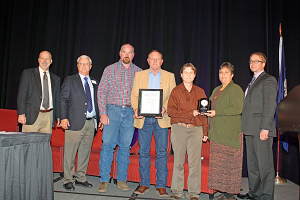
Last night NACD closed out the Annual Meeting with its Appreciation Banquet. The banquet is an opportunity for NACD to recognize the many outstanding individual efforts of conservation leaders from across the country.

The awards kicked off with the presentation of the NCDEA Awards for Outstanding Conservation District Board Member and Outstanding Conservation District Professional Employee. John Finch of Nash Soil and Water Conservation District in North Carolina and retiring Southeast Region Executive Board Member, received the award for outstanding district board member. Peter Vigil of the Taos Soil and Water Conservation District of New Mexico was the award winner for outstanding district employee.

One of the most prestigious awards of the evening is the NACD/NRCS Olin Sims Conservation Leadership Award. This year’s award recipient was Mike Thralls. Thralls was recognized for his superior service to the conservation community in promoting and leading conservation on private lands.

Rounding out the awards ceremony was the presentation of NACD’s top National Awards. The NACD Friend of Conservation award was presented to Charlie Shafer, president of Agri Drain Corporation and longtime supporter of soil and water conservation in Iowa and across the nation. Shafer has supported NACD as an exhibitor at the Conservation Expo, a sponsor of the NACD Annual Meeting, and by serving as the CTIC representative on the NACD Executive Board.

NACD’s Distinguished Service Award went to Don and Mary Jane Spickler. Don sadly passed away in the spring of last year, but his legacy to conservation will long be remembered. Mary Jane accepted the award for her and Don’s lifelong contributions. The Spicklers have been actively involved with conservation districts at the local, state and national level for over 42 years. While Don advanced from serving on his local district board to state and national positions, Mary Jane advanced in her position of involvement alongside Don through the NACD Auxiliary, supporting the soil and water stewardship program and the NACD poster contest. The Spicklers also developed a vision for the National Envirothon which they supported financially and through the dedication of their time and talent.

The final award of the night was the President’s Award which was presented to Tim Palmer. Palmer is an NACD Executive Board Member and farmer from Iowa. Palmer also Vice Chair of Madison County SWCD, NACD CTIC board representative, as well as serving on many other committee memberships within NACD.

Livecast from Tuesday’s General Session and Appreciation Banquet
Tuesday’s General Session and Appreciation Banquet was broadcast live over the internet thanks to Brian Allmer and BARN Media. The events will be archived and available on the BARN Media Livestream page or by visiting NACD’s Annual Meeting page.

NACD Welcomes New Officer Team
The NACD Annual Meeting Appreciation Banquet was capped off with the recognition of outgoing President Earl Garber, recognition of retiring NACD Officers and Executive Board Members, and the installation of new NACD Officers and Executive Board Members.

NACD would like to thank all the retiring Officers and Executive Board Members for their years of service.

The new NACD Officer team was announced with the installment of Lee McDaniel as the new NACD President. Former Second Vice President Brent Van Dyke of New Mexico was elected as First Vice President; former Secretary/Treasurer Dick Went of Rhode Island was elected as Second Vice President; and John McDonald, Executive Board member from Oregon, was elected as Secretary/Treasurer.

Annual Meeting Recap
This year’s Annual Meeting was attended by more than 900 guests. NACD would like to thank the attendees and all the sponsors of this year’s event in New Orleans. A special thank you to our meeting sponsors: Case I-H, Bob Warner, Monsanto, Apache, John Deere, the Maryland Association of Conservation Districts, the U.S. Forest Service, Bayer CropScience, Plum Creek, Verdesian, the USDA Department of Agriculture and NRCS, National Farmers Union, Syngenta, Agri Drain Corporation, and Scotts Miracle-Gro.
See you at the 2016 Annual Meeting in Reno
Please join us for next year’s Annual Meeting event in Reno, Nevada. The 2016 meeting will take place January 30 through February 3 at the Grand Sierra Resort and Casino.

Posted in Uncategorized | Leave a comment

NACD Meeting

Tuesday General Session Recap
Tuesday morning’s General Session featured presentations about the past, present and future of conservation.

Former NRCS Chief Dave White spoke on the history of conservation districts and the impetus the Dust Bowl had in bringing people together in locally-led land and soil conservation efforts.

Following Chief White’s address there was a panel discussion focusing on conservation today. Panelists included Karl Dalla Rosa, Forest Stewardship Program Manager, U.S. Forest Service; Ellen Gilinsky, Ph.D., Senior Policy Advisor, Office of Water, U.S. EPA; Kristin Thomasgard, Program Director, Readiness and Environmental Protection Integration (REPI) Program, Department of Defense; and Cynthia Moses-Nedd, Liason to State and Local Government, Bureau of Land Management.

Rounding out the program was current NRCS Chief Jason Weller who spoke about the vision for the future of conservation.

Livecast for Tuesday’s General Session and Appreciation Banquet
Tuesday’s General Session was broadcast live over the internet thanks to Brian Allmer and BARN Media. The event will be archived and available on the BARN Media Livestream page or by visiting NACD’s Annual Meeting page.

BARN media will also be livecasting tonight’s Appreciation Banquet from 7-9 PM CT. That will also be available on the BARN Media Livestream page or by visiting NACD’s Annual Meeting page.

NACD Live Auction Round-Up
Monday night’s Live Auction was a great success. The event raised over $75,000 for NACD’s Education and Outreach efforts to craft a positive policy and regulatory climate for conservation.

Among the many unique items that were auctioned off, NACD received a cash donation of $8,000 from John Deere. Additionally, Case I-H donated 100 hours of use on a new Magnum 340 CVT RowTrac which included an additional 100 hours of use for the purchaser’s local conservation district. Case I-H also made a surprise donation doubling its contribution.

The Live Auction is one of the signature events at NACD’s Annual Meeting. NACD thanks the districts, states and corporate sponsors for their donations to this year’s auction. We also extend a special thank you to Johnny Regula who has donated his time and services as a professional auctioneer for many years.

Earth Team Award
At Tuesday’s General Session NRCS Chief Jason Weller and NACD President Earl Garber presented the NACD-NRCS Earth Team Award. This year’s award was presented to Stone County Conservation District of Mountain View, Arkansas.

The Stone County CD was recognized as one of the most effective districts in helping with NRCS Earth Team Volunteers. The Stone County district employs 66 volunteers that help with programs and stewardship and education.

The Earth Team is the volunteer workforce of NRCS that helps conservation groups and others to ensure private lands are conserved, restored, and more resilient to environmental challenges like climate change. Working side-by-side with farmers and ranchers, the NRCS identifies natural resource concerns, such as soil erosion and water quality issues, and develops unique conservation plans for restoring and protecting resources

.

Spokane Summer Board Meeting Promo
Start making your plans to attend the Summer Board Meeting in Spokane, Washington. The meeting will take place July 11-13 at The Davenport Hotel. More information will be available on the NACD website in the coming months. You can also check out a short video about Spokane . We hope to see you this summer!
Posted in Uncategorized | Leave a comment

more from the NACD meeting

Monday General Session Recap
The 69th NACD Annual Meeting started off with a great General Session on Monday, February 2. Past NACD President Gene Schmidt presided over the event that included a keynote address by Major General Michael Wehr, Commander for the Mississippi Valley Division of the U.S. Army Corps of Engineers.

The program also included an address by current NACD President Earl Garber, NACD CEO John Larson and a Louisiana welcome address by Lt. Governor of Louisiana Jay Dardenne.

Other highlights of the program were a performance by the Chalmette High School girls choir led by Annelise Cassar, musical director, and the presentation of the colors by the Louisiana National Guard Youth Challenge Program.

Tuesday General Session Livecast
For those of you who were not able to attend this year’s Annual Meeting, you can follow along with us on Tuesday, February 3 when we will live-cast the General Session (9-11:30 AM CT) thanks to the generous services of Brain Allmer of BARN Media. The live webcast can be found on the BARN Media Livestream page or by visiting NACD’s Annual Meeting page.

NACD’s Annual Meeting page also has a link to the full meeting program, a template press release for attendees to use locally, and a link to the daily Annual Meeting coverage page. Don’t forget you can also follow along with us on Facebook (www.facebook.com/conservationdistricts) and Twitter @NACDconserve. Look for the hashtag #NACDAnnualMeeting.

Annual Meeting Leadership Luncheon
Monday’s Leadership Luncheon featured keynote speaker Krysta Harden, Deputy Secretary of Agriculture for the U.S. Department of Agriculture. Harden spoke to a full house of Annual Meeting participants about the importance of not only taking a leadership role, but in being a devoted leader.

Harden pressed the necessity of looking to the past for leadership cues, but not dwelling there at the expense of forward progress. "Look back, but don’t stare," Harden cautioned. "This is about the future," Harden added, "we can do more, we can do better and we can be in front."

Deputy Secretary Harden also spoke about recent Regional Conservation Partnership Program (RCPP) award decisions and the critical role of conservation districts in those accepted proposals. She spoke to the importance of harnessing the tools and relationships conservation districts already have in bringing new people and organizations together for conservation programs like RCPP.

"It’s about digging deeper, being stronger. The future has never been brighter or more hopeful for conservation districts if you remember what leadership is about," Harden said.

2015 Conservation Expo and Share Fair
Two highlights of the NACD Annual Meeting each year are the Conservation Expo and the Share Fair.

The Conservation Expo opened Sunday, February 1, with a record 34 exhibitors. Annual meeting attendees flocked to see exhibits that included representation from conservation-related businesses, nonprofit organizations and government conservation partners.

Soil health was a popular theme at several booths in this the International Year of Soils. Attendees also had a chance for a hands-on experience with the National Resources Conservation Service’s Client Gateway, which is being rolled out in phases across the country. The Expo will be open through Tuesday, February 3.

2015 marks the fourth year for the NACD District Share Fair. This year’s event showcased the accomplishments and programs of ten districts and state associations to more than 400 visitors.

Visit the NACD website to see the variety of projects shared at this year’s event. If you are interested in participating at the 2016 conference in Reno, Nev., applications will be available on the NACD Annual Meeting page next summer.

Posted in Uncategorized | Leave a comment

NACD Annual Meeting

February 1, 2015
NACD Kicks Off Annual Meeting in New Orleans
The National Association of Conservation Districts (NACD) kicked off its Annual Meeting today in New Orleans, Louisiana. The NACD Annual Meeting, February 1-4, brings together conservation leaders from across the nation for educational sessions, workshops and networking. Read the full press release here.

Monday’s keynote speakers will include: USDA Deputy Secretary of Agriculture Krysta Harden; Lt. Governor of Louisiana Jay Dardenne; and Commander for the Mississippi Valley Division of the U.S. Army Corps of Engineers Major General Michael Wehr. Tuesday’s General Session will focus on the past, present and future of conservation with former USDA NRCS Chief Dave White discussing the history of districts and the conservation movement; panelists representing the U.S. Bureau of Land Management, Environmental Protection Agency, Forest Service, Department of Defense, and Fish and Wildlife Service giving an update on current conservation efforts nationwide; and USDA NRCS Chief Jason Weller providing an outlook on the future of conservation in America.

During Tuesday’s Board of Directors meeting, elections will be held for the 2015 NACD Officer team.

This year, NACD in partnership with USDA NRCS will be hosting its first ever student program, bringing in Gulf Coast area college and university students to attend general sessions and a special student career workshop, where they’ll hear firsthand from local conservation districts, national and state partners, and private sector leaders on careers in conservation.

The week ahead: The Conservation Expo Hall opens tomorrow, Monday, February 2. Tomorrow also features the Share Fair and a full day of breakout sessions.

Kick-Off Event at Mardi Gras World
The 2015 NACD Annual meeting was kicked off with close to 200 people visiting Mardi Gras World. Participants were able to view floats lined up for a Mardi Gras parade that will be held soon. A movie highlighted the history of Mardi Gras and the parades.

All enjoyed king cake with a beautiful view of the Mississippi River. The evening ended with costumes and photos next to the beautiful Mardi Gras creations. The NACD Auxiliary hosted the event and money raised go toward the prize for the NACD poster and photo contest.

Posted in Uncategorized | Leave a comment

Cattle to the Rescue

Cattle To The Rescue

Can intensive grazing remedy invasive grass seeding blunder?

Pete Aleshire

Editor

928-474-5251 Extension: 127

As of Tuesday, January 27, 2015

Here’s a pottery barn approach to meddling with ecosystems: You broke it, you fix it.

Only problem: Turns out it’s a lot easier to mess things up than to set them right.

That’s one conclusion that emerges from a creative effort to use intensive cattle grazing to get rid of an invasive, ecosystem-wrecking exotic grass, deliberately seeded over thousands of acres after the Dude Fire in 1990.

The experiment focused on reducing the ecosystem tyranny of the weeping lovegrass planted by air in 1990 to prevent flooding and erosion after the intense crown fire that seared the soil across 28,000 acres.

Rim Country rancher Ray Tanner teamed up with the U.S. Forest Service, researchers from Northern Arizona and others to determine whether concentrating cattle in an area overrun by weeping love grass would actually allow many other grasses and shrubs to get a roothold in an area dominated almost entirely by the domineering, non-native grass.

The two-year effort enjoyed limited success. It increased the amount of bare ground and encouraged a greater diversity of other grasses. But the effects faded quickly after the rancher returned cattle numbers to normal and stopped concentrating them in certain areas.

The researchers concluded the experiment could have produced a long-term effect if continued for a longer period and carefully controlled, according to the results in Rangeland, published by the Society for Range Management.

Researchers included Chris­topher Bernau, Jim Sprinkle, Ray Tanner, John Kava, Christine Thiel, Vanessa Prileson and Doug Tolleson.

The study adds to an intriguing set of studies that suggest careful management of cattle can improve the condition of rangelands, which remain in degraded, stressed-out condition across Northern Arizona. Uncontrolled grazing in the early 20th century transformed grasslands and pinyon-juniper and ponderosa pine forests like those surrounding Payson. Those changes resulted in a drastic reduction in the number of cattle the U.S. Forest Service allows on the range, devastating changes in wildfire patterns and the near extinction of family ranch operations.

The effort to control weeping lovegrass demonstrates the complexity of the system — and the difficulty ranchers and land mangers face in restoring a natural balance once things get out of whack. The lovegrass came originally from Africa and grows in bunches up to six feet tall, overshadowing and driving out other plants growing on the ground. The plant grows quickly, can produce 30,000 seeds annually and sets down a 13-foot-deep root system. However, it provides relatively poor forage for cattle and other wildlife once it matures. It also can survive droughts that would kill off competitors.

The Dude Fire in 1990 ushered in a frightening new era in wildfire behavior. The fire burned 28,000 acres, which at that time made it the biggest fire in recorded state history. Several fires since then have exceeded 500,000 acres.

Nonetheless, the Dude Fire shocked fire managers — and killed six firefighters. The fire produced 100-foot-long flames, destroyed 67 structures and consumed 36 million board feet of timber. It also destroyed almost every tree in its path and superheated the soil, making it hard for plants to get re-established and posing the risk of flooding and devastating erosion.

So the Forest Service scattered 210,000 pounds of seed by air. The reseeding effort relied mostly on non-native grasses, since land managers had few sources of native seeds and feared they wouldn’t germinate on the altered soil.

The re-seeding effort included 20 percent native western wheatgrass and 76 percent non-native grasses. Weeping lovegrass accounted for just 3 percent of the seeds scattered, according to a background summary in the Rangelands article.

The aerial effort amounted to a total of some 56 billion seeds, about 52 seeds per square foot.

As it turned out, the lovegrass proved far better at sprouting in the altered conditions than any other seeds. By 2005, lovegrass had created a near-monoculture on 90 percent of the 21,000 acres re-seeded.

Lovegrass “has outcompeted native vegetation and degraded habitat quality for wildlife and domestic animals. Today, ecologists describe these areas as a biological desert,” the researchers concluded.

Tanner asked the researchers if they could help him reduce the impact of lovegrass that covered 90 percent of his allotment on the Little Green Valley Complex near Payson.

Payson Ranger District rangeland specialist Christine Thiel, NAU professor Jim Sprinkle and other researchers joined in the effort.

The Forest Service agreed to let Tanner put out protein supplements beloved by the cattle, which would have the effect of concentrating the livestock in smaller areas. The concentration effectively increased grazing intensity by about 60 percent. Tanner tried the experiment with 300 beef cows and 50 yearlings grazing in a 4,000-acre pasture. They compared the results to a similar pasture without the more intense grazing.

After two years, the intense grazing reduced the area dominated by lovegrass from 93 percent to 86 percent. The other perennial grasses increased from 35 percent to 62 percent and the other annual grasses increased from 6 percent to 40 percent. The amount of bare soil increased from 7 percent to 12 percent and the amount of litter on the ground from the bunchgrass decreased from 84 percent to 73 percent.

However, soon after the experiment ended, the tenacious bunchgrass re-established its hold on the rangeland.

The researchers concluded the cattle not only ate the bunchgrass when they had no alternatives, but that their hooves tended to break up the tussocks of grass when grazing reached a certain intensity.

The researchers concluded that to have any long-term effect on the lovegrass, ranchers would have to keep the intensive grazing going much longer and perhaps replant native grasses — which the action of the cattle’s hooves could work into the soil.

Interestingly enough, the cattle essentially forced to eat the lovegrass acquired a taste for it. “It seems the cows on the ranch now use lovegrass regularly and without protein supplementation directing them. Ray Tanner compares the behavior to priming a pump, that is, that the study ‘primed’ the cows by getting them used to the idea of eating lovegrass. Once acclimated to that new diet, they simply continued the behavior into the following years,” the researchers concluded.

Tanner himself wrote, lovegrass “needs to be grazed very intensely and at higher rates than normally permitted by the Forest Service, perhaps 60-80 percent and should be grazed every year to avoid the return of the dense canopy of old, mature lovegrass that shades out more desirable species.”

He said ranchers should now experiment with introducing native grasses in conjunction with the more intense grazing on the lovegrass at key times of the year.

“All this being said, I would not recommend planting weeping lovegrass on public lands. But for those who have it, targeted grazing is something that can be done to improve use and species diversity that works better than cussing it.”

Posted in Uncategorized | Leave a comment